Breast Augmentation
Home > Plastic Surgery > Breast Augmentation
Breast Augmentation In Dubai
Breast augmentation in Dubai at Highness Clinics is an advanced cosmetic solution designed to enhance the size, shape, and contour of the breasts, providing a fuller and more balanced silhouette. Unlike non-surgical procedures, breast implants offer a consistently shapely and proportionate result, catering to individuals who seek a dramatic improvement in their breast enhancement goals.
Breast augmentation in Dubai is a sought-after option for individuals aiming to achieve a well-defined, rounded appearance, especially if they have naturally small breasts or have experienced volume loss due to aging, weight fluctuations, or pregnancy. This procedure is ideal for those who desire long-lasting results that emphasize symmetry and a natural contour. Breast augmentation can also be combined with complementary treatments, such as liposuction or skin tightening, to further refine the overall body shape.
The primary goal of breast augmentation is to enhance the volume and improve the symmetry and projection of the breasts, creating a harmonious balance with the rest of the body. Unlike fat transfer methods, which depend on the availability of donor fat, implants offer predictable results that are customizable to each patient’s unique aesthetic goals. The procedure involves placing implants securely beneath the breast tissue or chest muscles to create a natural-looking enhancement.
At Highness Clinics, breast augmentation is performed by Dr. Elias Zgheib, our Mia Femtech™ Certified Surgeon, using advanced techniques to deliver safe, precise, and aesthetically pleasing outcomes. Whether you’re seeking a subtle increase in volume or a more pronounced transformation, every step of the procedure is customized to align with your goals and body structure, ensuring beautifully enhanced breasts that complement your natural curves and boost your confidence.
Benefits of Breast Augmentation
- Enhanced Volume and Shape: Increases breast size and enhances natural curves for a fuller, more youthful appearance.
- Improved Symmetry: Corrects asymmetry, providing a more balanced and proportionate figure.
- Boosted Confidence: Feel more confident and comfortable in your own body with enhanced breast shape.
- Restoration of Volume: Restores lost breast volume after pregnancy, weight loss, or aging.
- Customizable Results: Personalized approach with a variety of implant sizes and types to suit your desired outcome.
Am I A Good Candidate For Breast Augmentation In Dubai?
Any woman could be a good candidate for Breast Augmentation In Dubai as long as they:
- Are in good overall health and have realistic expectations for the results of the procedure.
- Are looking for a long-lasting solution to improve the projection and symmetry of their breasts.
- Want to achieve a more youthful and shapely appearance by increasing breast volume and enhancing their natural contour.
- Are a non-smoker, or willing to stop smoking before and after surgery, as smoking can significantly affect healing and results.
- Have finished breastfeeding, or do not plan to breastfeed in the near future, since breast size and shape can change afterward.
- Have fully developed breasts and are not planning significant future weight changes that could affect long-term results.
Choosing the Right Breast Augmentation Technique for You
Breast augmentation at Highness Clinics isn’t one-size-fits-all. While traditional implant-based augmentation remains a trusted, proven option for patients seeking significant volume and shape change, we also offer two specialized alternatives for patients with different priorities — whether that’s avoiding general anaesthesia, minimizing invasiveness, or prioritizing long-term tissue preservation. Each technique uses a different approach to achieve natural, lasting results, and your surgeon will help determine which is right for you based on your goals, anatomy, and lifestyle.
These two techniques — Mia Femtech® and Preserve™ — are outlined below alongside traditional augmentation, so you can see at a glance how they compare.
Traditional Augmentation
Technique
Implant placement via incision
Implant Type
Silicone or saline
Best for
Significant volume increase
Mia Femtech
Technique
Injectable, no incision
Implant type
Injectable, biocompatible implant
Best for
Discreet, proportional enhancement
Preserve
Technique
Tissue-preserving placement
Implant Type
Best for
Long-term tissue health priority
Understanding the Breast Augmentation in Dubai Procedure
Initial Consultation
The breast augmentation process at Highness Clinics in Dubai begins with a comprehensive initial consultation. During this session, the doctor assesses the patient’s breast shape, skin condition, and overall health to determine their suitability for the procedure. The patient’s medical history is reviewed, and they are encouraged to share their aesthetic goals, ask questions, and address any concerns regarding the surgery, recovery, and expected results. The consultation also involves discussing implant sizes, shapes, and placement techniques to achieve the desired outcome.
Procedure
Breast augmentation surgery involves advanced techniques to enhance the size, shape, and contour of the breasts, creating a fuller and more balanced appearance. The procedure begins with carefully planned incisions, typically made under the breast, around the areola, or in the armpit to minimize visible scarring. Silicone or saline implants, tailored to the patient’s desired shape and volume, are securely placed either beneath the breast tissue or beneath the chest muscles. The implants are positioned symmetrically to ensure a natural and balanced result. The incisions are then closed with precision to promote optimal healing and a seamless appearance.
Post-treatment Care and Guidelines
After breast augmentation surgery, patients receive detailed post-care instructions to support recovery and achieve the best results. It is essential to avoid strenuous activities, lifting heavy objects, or engaging in intense exercise during the initial recovery period. Patients are advised to wear a supportive bra as directed and to follow the surgeon’s guidelines closely. Mild swelling, bruising, and discomfort are common but subside over time. Regular follow-up appointments are scheduled to monitor healing and ensure proper implant positioning.
Expected Results of Breast Augmentation in Dubai
Breast augmentation provides enhanced volume, improved shape, and a more proportionate silhouette. Patients can expect fuller, rounder, and more symmetrical breasts that complement their overall body contours. As swelling decreases, the final results become more apparent, revealing a natural and aesthetically pleasing enhancement. Maintaining results involves following the surgeon’s post-care advice and leading a healthy lifestyle.
For a comprehensive transformation, breast augmentation can be combined with other procedures such as liposuction or skin tightening to further refine the overall body shape.
Timeframe
What to Expect
Day 1–3
Tightness, swelling, mild discomfort; rest and light movement advised
Day 4–7
Significant comfort improvement; light daily activity resumable
Week 2
Most patients return to desk work; surgical bra worn full-time
Week 4–6
Swelling reducing; implants beginning to soften and settle
Week 6+
Exercise and upper body activity cleared by Dr. Elias
Why choose Highness Clinics for your Breast Augmentation in Dubai
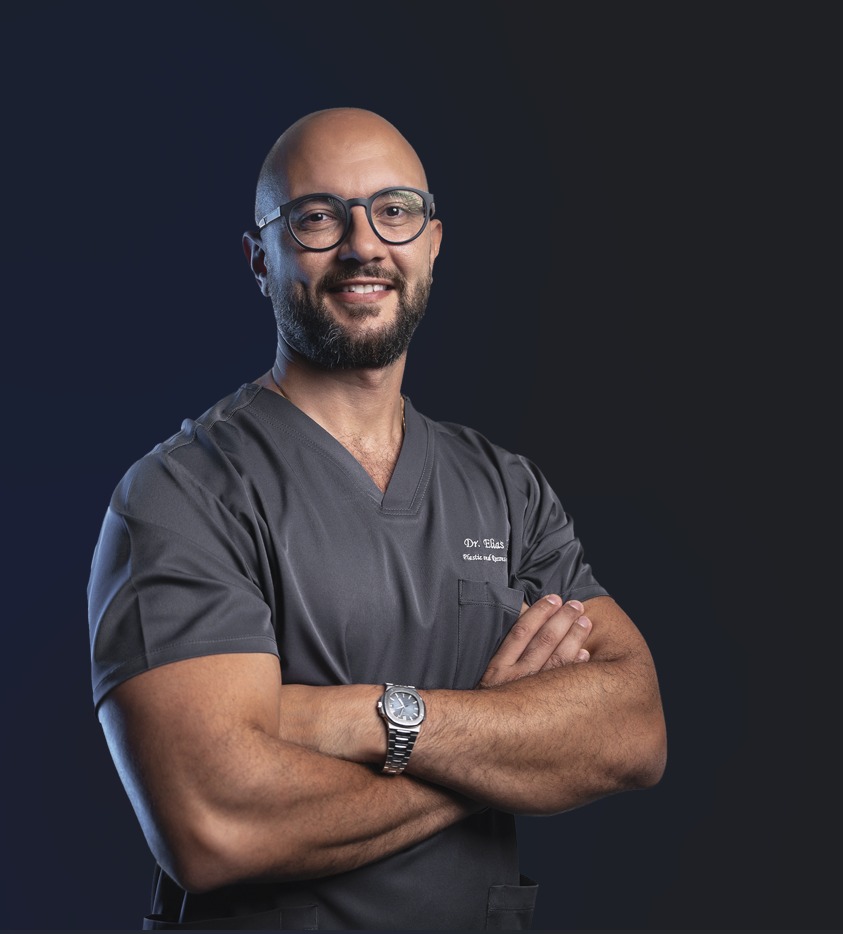
Meet Dr. Elias Zgheib
Board certified plastic surgeon, Highness Clinics
Trained at the American University of Beirut, with fellowships at Great Ormond Street Hospital and Royal London Hospital. Has performed over 500 breast procedures and more than 1,000 cosmetic and reconstructive surgeries in total.
Trained at
American University of Beirut
Cosmetic and reconstructive procedures
1000+
Certified By
Breast procedures
500+
Surgical Approach & Implant Placement For Breast Augmentation in Dubai
Incision location and implant position are chosen based on your anatomy, implant type, and aesthetic goals.
Approach
Location
Best For
Inframammary
A discreet incision placed directly in the breast’s natural crease.
The most frequently chosen technique, offering excellent control over implant placement and pocket precision. Because the scar falls within the breast fold, it stays concealed even in swimwear.
Periareolar
An incision following the lower border of the areola, at the point where pigmented skin transitions to breast tissue.
Ideal for patients with sufficiently sized areolas. As healing progresses, the scar settles into the areola’s natural edge and becomes barely noticeable.
Transaxillary
An incision hidden within the natural fold of the underarm.
Avoids any scarring on the breast entirely. This technique demands specialised surgical skill and suits particular implant choices and body types. Dr. Elias will confirm candidacy at consultation.
Understanding Implant Placement
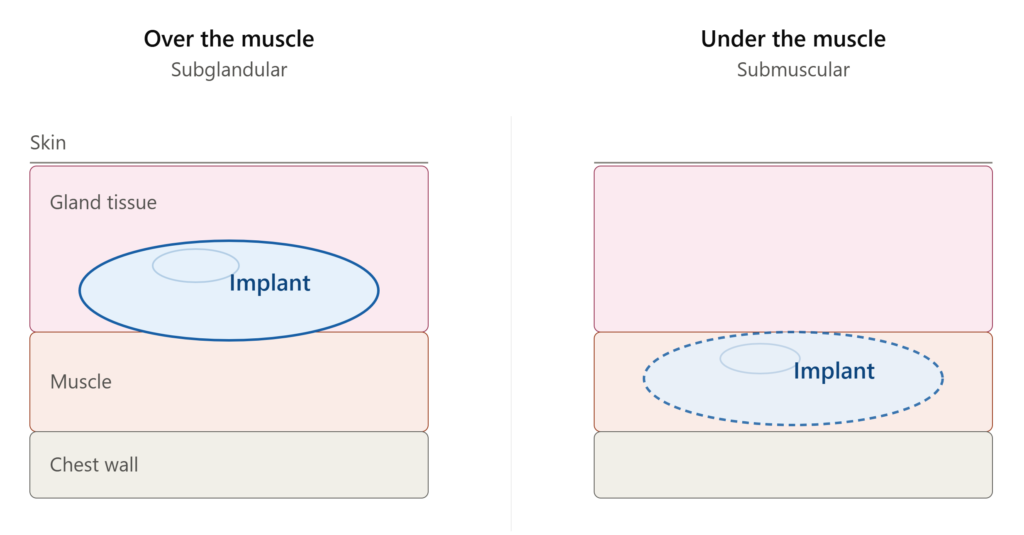
Where your implant sits relative to the chest muscle affects how it looks, feels, and heals — and it’s one of the key decisions made during your consultation with Dr. Elias Zgheib.
Over the muscle (subglandular)
The implant sits above the pec muscle, directly beneath the breast tissue. This typically means a shorter, more comfortable recovery, since the muscle itself isn’t disturbed. It’s often preferred by patients with enough natural breast tissue to fully cover the implant, and it can allow for more precise shaping in certain cases.
Under the muscle (submuscular)
The implant sits behind the pec muscle, closer to the chest wall. This placement can reduce visible rippling and gives a softer, more gradual transition at the upper edge of the breast — often the preferred choice for patients with thinner natural tissue. Recovery is generally a little longer, since the muscle needs time to adjust.
Many patients fall somewhere in between, which is why a dual-plane technique — combining both approaches — is also commonly used to balance the benefits of each.
Breast Augmentation in Dubai - FAQ
How long does the recovery take?
The initial recovery period typically lasts about 1-2 weeks, with most patients resuming normal activities after 4-6 weeks. Swelling and discomfort are common but subside over time. Strenuous activities and heavy lifting should be avoided during the recovery period.
How long do breast implants last?
Breast implants are not designed to last a lifetime. On average, implants can last 10-15 years, but they may require replacement or removal over time. Regular check-ups with your surgeon are recommended to ensure the implants remain in good condition.
Will breast augmentation affect breastfeeding?
Breast augmentation generally does not interfere with the ability to breastfeed, but the placement of implants (under the muscle or over the muscle) may impact this. Discussing concerns with your surgeon prior to the procedure is important if you plan to breastfeed in the future.
Will the implants feel natural?
Silicone implants are widely considered by surgeons to provide a more natural feel compared to saline implants. However, the overall sensation depends on factors such as implant type, size, and placement. Surgeons will discuss the best options for achieving a natural-looking result based on individual anatomy.
Where are breast implants placed — over or under the muscle?
Breast implants can be placed either over the muscle (subglandular), positioned between the breast tissue and the chest muscle, or under the muscle (submuscular), positioned beneath the chest muscle for added coverage and a smoother, more natural-looking result. Placement over the muscle typically means a shorter recovery, while placement under the muscle can reduce visible rippling and may be preferred for patients with less natural breast tissue. Many surgeons also use a dual-plane technique, combining both approaches for a balanced result. Your surgeon will recommend the best placement for your anatomy and goals during consultation.
What are the risks of breast augmentation?
As with any surgical procedure, breast augmentation carries some risks, including infection, bleeding, changes in nipple or breast sensation, asymmetry, and capsular contracture (firming of the tissue around the implant). Rare but more serious risks include implant rupture or a condition called BIA-ALCL, associated with certain textured implant surfaces. These risks are minimized through careful surgical technique, implant selection, and post-operative care — your surgeon will discuss your individual risk profile in detail during consultation.
How can I tell if my breast augmentation recovery is going well?
Mild swelling, tightness, and some discomfort are normal in the first one to two weeks. Most patients return to light daily activities within a few days and resume exercise around four to six weeks, depending on their surgeon’s guidance. Contact your surgeon promptly if you experience increasing pain, fever, unusual swelling, or discharge, as these can be signs of infection or other complications requiring attention.
How much does breast augmentation cost in Dubai?
The cost of breast augmentation varies depending on the implant type, technique, and individual treatment plan. Dr. Elias Zgheib provides a detailed, personalised cost breakdown during your consultation, after assessing your anatomy and goals. There are no hidden fees, and no obligation to proceed after your consultation.
Round vs. teardrop implants — which is right for me?
Round implants provide fuller upper-pole volume and a more symmetrical look regardless of positioning, while teardrop (anatomical) implants taper to mimic the natural slope of the breast for a subtler, more gradual result. The best choice depends on your natural breast shape, body proportions, and desired outcome — your surgeon will help determine which suits you during consultation.
Get the Treatment You Deserve!
Book Your Appointment Now
CONTACT US
LOCATION
Ibn Zuhr Building #53
Dubai Healthcare City
CALL
+971 4 443 2162
+971 58 820 2456
HOURS
Everyday
10am – 9pm
info@highnessclinics.ae
MOH APPROVAL: Q6C1V34X-260725